Submit
Upload or paste the text
Submit a .doc, .docx, .txt, or .pdf file, or paste text directly. 300 or more words of English gives the most reliable result.

Dechefr is a structured professional judgment tool that assesses written or transcribed communication for the risk of targeted violence. It evaluates emails, posts, letters and messages against twelve research-grounded indicators, producing a result ready for a trained assessor to review.
Need to manage the whole case, not just one text? Dechefr also runs inside Sentinel, our guided solution for reporting, assessing, and managing
conflict, threats, and violence.
Written communication can carry indicators that bear on risk, from grievance and fixation to leakage and last-resort escalation, and reading them consistently takes a defined method rather than an experienced eye alone. Dechefr, from the French déchiffrer, to decipher, is a structured professional judgment (SPJ) tool built for that. It assesses a piece of writing or a transcript against twelve research-based indicators drawn from the literature on warning behaviors and the pathway to violence, and returns each indicator with an overall risk level. As with any SPJ instrument, the result structures the assessment rather than settling it. The judgment stays with a trained assessor.
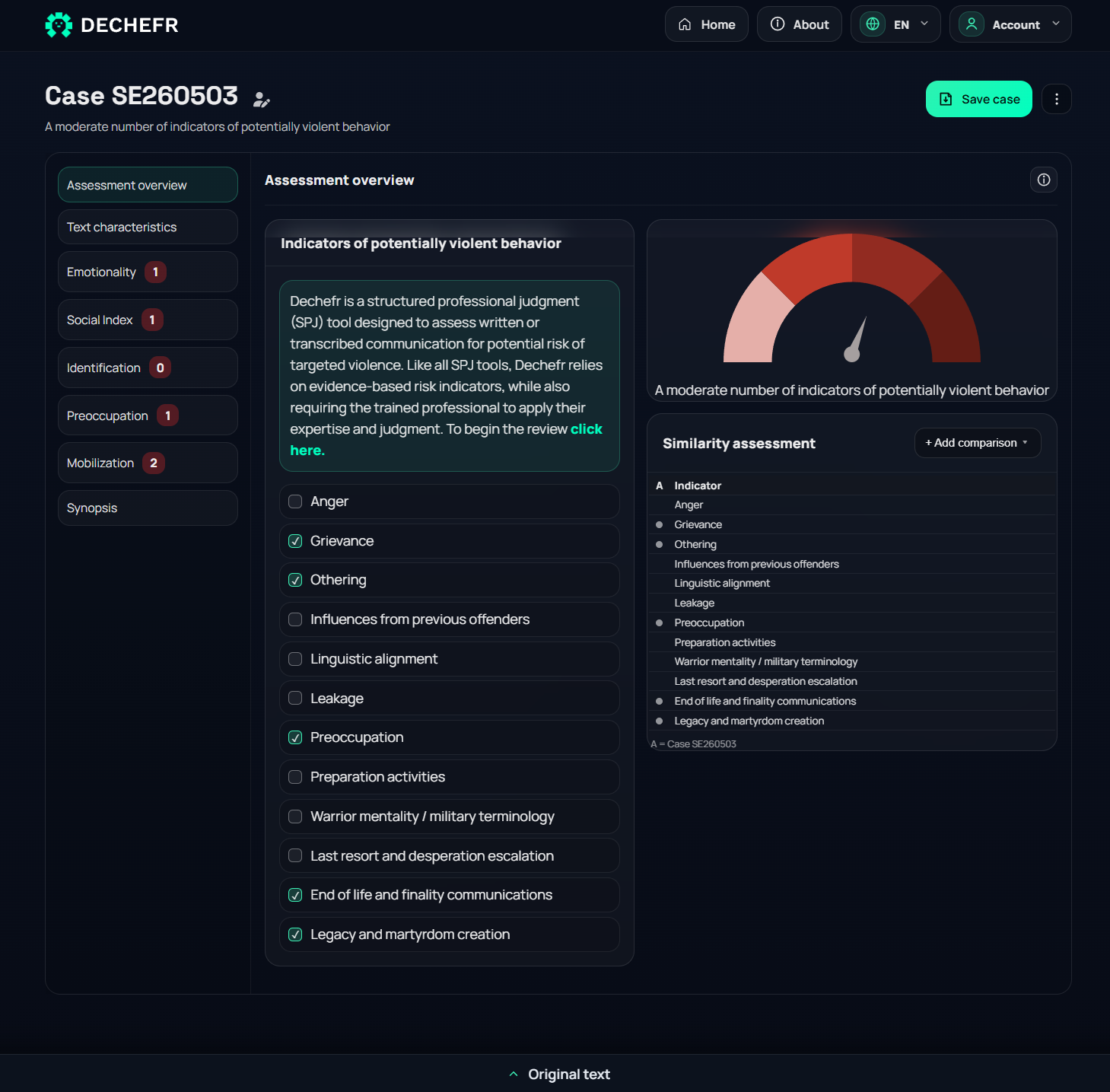
Dechefr turns a document or pasted text into a structured, transparent assessment in four steps.
Submit a .doc, .docx, .txt, or .pdf file, or paste text directly. 300 or more words of English gives the most reliable result.
A weighted overall risk level gives a fast triage signal across four levels, from no indicators present to several significant indicators of potentially violent behavior. Review each of the twelve indicators with an interactive assistant, and adjust any call based on your own judgment.
See how the case compares against a reference database of violent offenders' communications and against your own case archive, showing which patterns recur and which details are particular to this case.
A structured report documents every indicator, the sentences behind it, and the overall risk level, giving you a record of how the assessment was reached.
Dechefr assesses the text and only the text. It is not swayed by who wrote it, by internal pressure, or by the fatigue that builds over a long caseload, and it applies the same criteria to the hundredth message as to the first. That makes it a stable second opinion for assessors to weigh their own judgment against, whether it runs on its own or inside Sentinel.
Dechefr looks for twelve indicators, drawn from the literature on warning behaviors and the pathway to violence.
Expressions in the communication that indicate anger.
An unmet need that fuels a sense of being wronged, the kind that can drive revenge or retribution.
Us-versus-them thinking that marginalizes a "them" group as an outgroup.
Communication of intent to harm a specific target.
Interest in or admiration for previous offenders or attacks.
Military jargon and the adoption of a warrior perspective.
Extreme occupation with a person or cause.
Linguistic markers of influence from an ideology or subculture.
Violent ideation being converted into operational capability.
Violence perceived as the only remaining option, with urgency and closing alternatives.
Anticipation or acceptance of death, capture, or irreversible consequences.
Violence framed as historic, justified, or worthy of remembrance.
The same assessment engine and the same twelve indicators, whether Dechefr stands alone or sits inside Sentinel. Start with the scope your team needs today, and add the case-management layer when you're ready.
For analysts, forensic linguists, and researchers who need to assess a single piece of written communication.
For teams that receive reports and manage cases end to end, not just single texts.
Campus threat assessment teams managing student-of-concern reports and communications.
Corporate security and HR handling workplace violence prevention and insider concerns.
Agencies and authorities receiving threats and hostile communications directed at staff and officials.
Professionals assessing threatening communications as part of protective operations.

Contact us for more information, and we'll walk your team through the full workflow where you assess and manage conflict, threats, and violence, using realistic material.
Contact usLeave your email and we'll get in touch with details on Sentinel and Dechefr.